

How to Actually Do a Frequency Audit (The 4-Part Method)
Stop guessing what works in your closet. This step-by-step frequency audit will show you which pieces are generating returns and which ones are blocking your frequency.

SophistiSundays is brought to you on a Tuesday today, because it turns out that building the world’s best digital personal styling, closet organization and shopping assistant app comes with a lot of surprises.
Last week I told you that your closet and what you wear is having a conversation with the universe.
This week, we’re going to listen to what it’s actually saying.
Most of us have no idea what’s in our closets. We know the pieces we wear constantly. We know the ones we avoid. But we’ve never really looked at the whole picture together.
I’ve done this work on my own and for my loved ones many times now, and it wasn’t until I slowed down that I realized the pattern is always the same. We think we know what we own. Then we pull everything out and realize we’ve been operating on autopilot for years. Seeing all the similar yet still not quite right pieces, the lower quality version of the top we really wanted, the uncomfortable heels we keep in the back corner just in case - and, the best one: finding clothes we don’t even remember buying or even belong in an outfit because we were shopping on autopilot (I’ll definitely be writing about emotional shopping in the near future!).
So today, I’m walking you through the exact process I use. The one I teach in The Collective. The one that helped me go from a closet stuffed with things that made me feel small to a wardrobe that actually supports who I’m becoming.
This is the Frequency Audit. And it’s simpler than you think.
A Different Kind of Organization
A frequency audit is about awareness, plain and simple.
You’re organizing by energy. Which pieces make you expand and which ones make you contract. Which pieces are you reaching for when it matters and which ones are you negotiating with every morning.
The audit has four layers. Each one reveals something different about what’s working and what’s blocking you.
You don’t have to do all four layers in one day. In fact, I don’t recommend it. This is a process. Processes take time.
Start with Part 1. See what you notice (or journal - you’ll come to learn that I cannot advocate enough for journaling). Then come back to Part 2 when you’re ready.
Take your time. This work doesn’t expire.
Part 1: The Frequency Sort
Take everything out of your closet. Yes, everything.
I know that sounds overwhelming. You need to see it all together though. When clothes are hidden in the back of your closet or stuffed in drawers, they don’t exist. They’re just taking up space.
Pull it all out. Put it on your bed, on the floor, wherever you have room.
Now sort everything into three piles.
Pile 1: Expands
These pieces make you feel more like yourself. When you wear them, you feel confident, powerful, aligned. You don’t have to think about them. They just work.
Pile 2: Contracts
These pieces make you feel smaller. When you put them on, something feels off. Maybe they don’t fit right. Maybe they’re attached to a version of you that doesn’t exist anymore. Maybe they just drain your energy every time you see them. You wear these pieces sometimes because you have to, and every time you do you can’t wait to get home and change clothes.
Pile 3: Neutral
These pieces are fine. They’re functional. Basic. Safe. They’re neither helping nor harming you.
Don’t overthink this. Your body knows. If you have to convince yourself that something belongs in Pile 1, it doesn’t belong in Pile 1.
This sort will take 1-2 hours depending on how much you have. Put on music. Make it meditative. This is the foundation of everything else.
Looking at the Piles
Once you’ve sorted everything, look at the piles.
Really look at them.
Pile 1 (Expands) is usually way smaller than anyone expects. Sometimes it’s just 15-20 pieces.
Pile 2 (Contracts) is usually bigger than expected but also not surprisingly; if you find it overwhelming or hard to get dressed each day it is likely because so many of these pieces were taking up space. I’ll talk about this more later, but trying to build a wardrobe around pieces you don’t love to begin with only creates a cycle of buying more subpar stuff. The $150 barrel pants that looked way better on me in the dressing room than in the real world - I’m looking at you.
And Pile 3 (Neutral) is massive. All those pieces you bought because they were on sale or because you thought you should have them or because you needed something quick.
Most of your closet isn’t actively supporting you. It’s noise. And noise dilutes frequency.
Part 2: The Star Performer Analysis
Take Pile 1 and lay these pieces out where you can see them.
These are your star performers. The pieces that are already working. Now we figure out why.
Look at each piece and ask yourself:
How often do I actually wear this? Daily? Weekly? Only for special occasions?
What does this pair with? Can I build 5+ outfits around this, or does it only work with one specific thing?
How does this make me feel when I wear it? Confident? Professional? Creative? Powerful? Comfortable?
What’s the cost per wear? If I paid $200 and wore it 50 times, that’s $4 per wear. That’s a good return.
Has anything good happened while wearing this? Job offer after wearing it during the interview process? Have a great client meeting? Compliments or free stuff? General confidence and badassery?
Write this down. Get a journal or open your notes app and actually track this.
You’re going to start seeing patterns.
Maybe all your star performers are a specific color. Maybe they’re all a certain silhouette. Maybe they all came from one particular brand or price point.
Those patterns are data. And data tells you what to do next.
I realized last year that almost all my star performers are natural fibers. Cashmere, wool, cotton, denim. Meanwhile, everything in my Pile 2 was polyester or rayon. My body was trying to tell me something. I just hadn’t been listening.
The SophistiStock Advantage
This is exactly why I built the app.
Tracking this stuff manually is fine, but it’s tedious. And when something is tedious, we stop doing it.
SophistiStock lets you log each piece, track how often you wear it, calculate cost per wear, and tag how it makes you feel. Over time, you’ll see which pieces are actually generating returns and which ones are just sitting there.
The app isn’t required to do a frequency audit. But it makes it easier to sustain the practice long-term.
You can try it for free for as long as you want to see if it helps.
Part 3: The Contraction Conversation
Now we look at Pile 2. The pieces that make you contract.
This is the hardest part for most people. These pieces usually have stories attached to them.
“I spent so much money on this.”
“This was a gift.”
“I’ll fit into it again eventually.”
“I might need it someday.”
I get it. I’ve had all those thoughts too.
But here’s the better question: Is this piece serving who I’m becoming, or is it anchoring me to who I was?
If it’s the latter, it needs to go.
I don’t care how much you spent. I don’t care if it still has the tags on it. I don’t care if it was expensive or sentimental or “perfectly good.”
If it makes you feel small every time you see it, it’s blocking you.
You don’t have to get rid of everything in Pile 2 today. But you do need to be honest about what’s in there and why you’re keeping it.
Start with 5 pieces. Pick the ones that feel the most draining. Donate them, sell them, or give them to someone who will actually wear them. Keep chipping away at the pile. It is important to not be impulsive in this step as you don’t want to give away something that could be a star player for you just because it was orange and you were having a navy kind of day.
This might feel overwhelming or cause a bit of guilt, but creating space is lighter than you think. I promise. I’ve been there too.
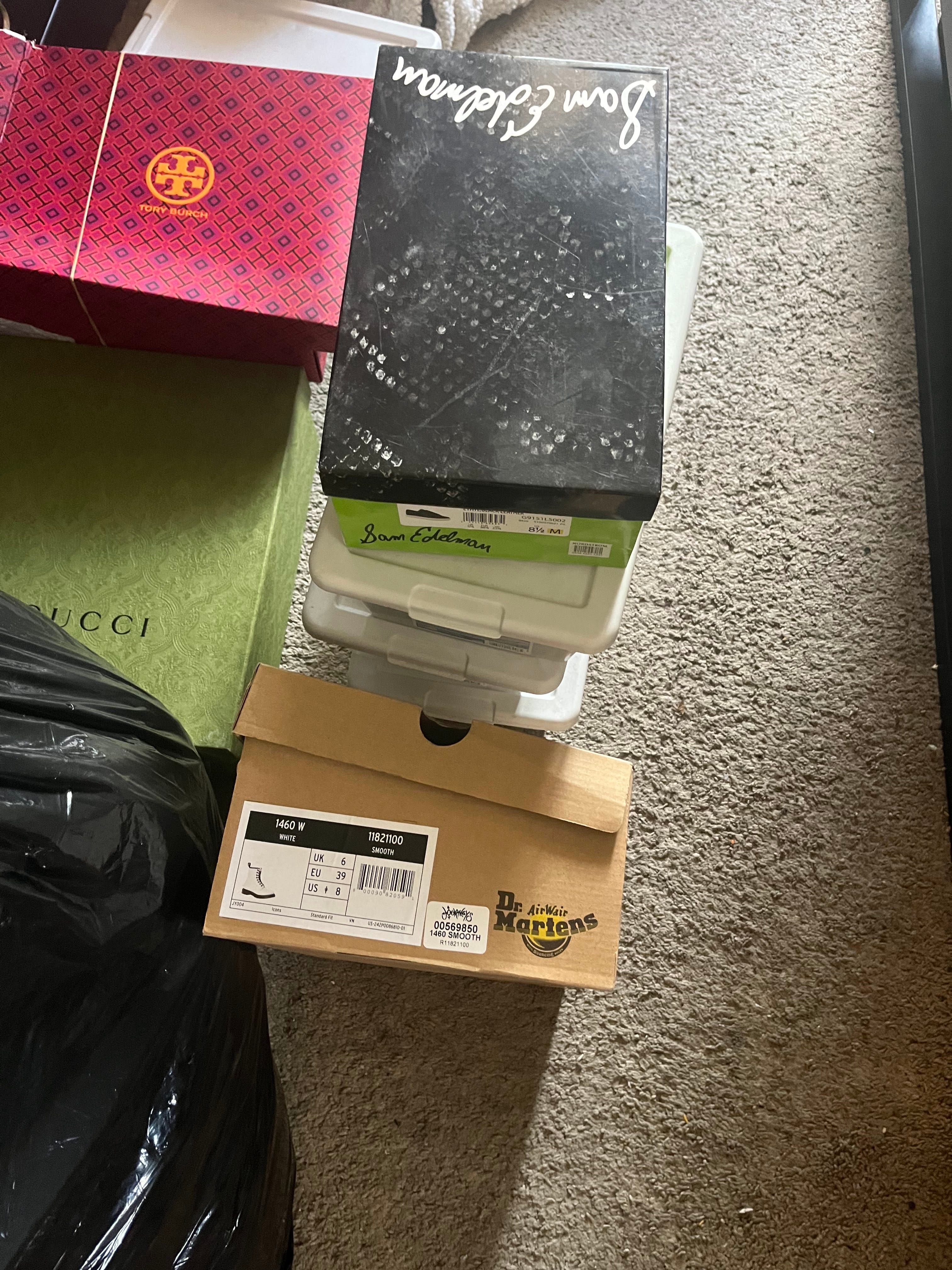
- a little bit of my pile 2, I still have the Tory Burch and Gucci for the record; they were moved to pile 3 😂 -
Part 4: The Strategic Build
Now that you know what works and what doesn’t, you can start building intentionally.
Look at your star performers again. Notice what’s missing.
Maybe you have amazing tops but your bottoms are all neutral and boring.
Maybe you have great professional pieces but nothing that feels creative or expressive.
Maybe you have casual covered but you’re avoiding anything that feels too powerful because you’re not sure you can pull it off yet.
Those gaps are information.
Don’t rush to fill them.
Most of us have been conditioned to see a gap and immediately buy something to fill it. That’s how we ended up with closets full of things that don’t work.
Get intentional about what you actually need instead.
If you need bottoms that pair with your favorite tops, what would those look like? What fabric? What cut? What color family?
If you need something that feels more powerful, what would that piece be? A blazer? A heel? A specific silhouette?
Write it down. Be specific. Then start looking. Do research, rent clothes, go try clothes on in person instead of ordering online and hoping things fit. (Admittedly though online shopping is great once you know how brands fit you - just be sure to check return policies.)
Wait until you find the right piece.
One intentional purchase that you’ll wear 100 times is worth more than ten impulse buys that sit in your closet unworn or unexcitedly worn.
After the Audit
You’re going to feel a weight off your shoulders.
Your closet might be physically lighter, but that’s not really the point. The mental load of negotiating with pieces that don’t serve you is gone. That’s the real shift.
Getting dressed will be easier. You’ll reach for things with confidence because you know they work.
You’ll stop buying things that don’t fit your frequency. Because now you know what your frequency actually is.
And over time, you’ll notice something else. Opportunities start showing up differently.
This is alignment at its core. When you’re no longer spending mental energy managing a closet full of noise, that energy goes somewhere else. Usually toward the things you’ve been trying to manifest.
Track the Pattern
Here’s what I want you to do after you complete your audit.
Pay attention for 30 days.
Notice how you feel getting dressed. Notice what opportunities show up. Notice if anything shifts in how people respond to you.
This is how you learn what works. By data, not by theory.
Your frequency audit isn’t a one-time event. It’s a practice. You’ll do it again in three months. Then six months. Then whenever you feel like your closet has gotten out of alignment again.
Every time you do it, you’ll get more refined. You’ll know yourself better. You’ll build more intentionally.
That’s the point. Evolution, not perfection.
Your Next Step
Try to start Part 1 this week.
Pull everything out. Sort into three piles. See what you’re actually working with.
Then come back to this essay next week and do Part 2.
You don’t have to rush this. I’d rather you do it slowly and thoughtfully than quickly and haphazardly. Don’t forget to join The Collective for additional support and to share how it’s going for you.
This work compounds. Small, consistent actions over time create massive transformation.
You’re not just organizing your closet. You’re designing your frequency.
That’s worth taking your time to do well.
Drop a comment and tell me: Have you ever done a closet audit before and what surprised you most about what you found?
I’d love to hear what comes up for you as you do this work.
Have your friends join in on the fun too, share this post with them.
Next week: The Investment Tiers. How to decide what’s worth spending money on based on frequency returns instead of trends.
If you want to keep track of the latest in frequency fashion, wealth architecture and my journey towards transforming as many closets as possible with SophistiStock hit that Subscribe button.
Until next time frequency fashionista,
Marie